
New Listings Signal a Slow but Steady Path Back Toward a “Normal” Housing Market
"According to new data from First American, home sales are still slow after a protracted period of muted activity, with the rate of sales still hovering around 4 million yearly. The Existing-Home Sales Outlook predicts a little increase in October since demand is still high but transactions have been hampered by a lack of supply and issues with affordability. The slight improvement on the supply side is one cause for cautious optimism. One of the market’s most persistent bottlenecks has been addressed as new listings have grown yearly and approached pre-pandemic levels.
Why revisit pre-pandemic levels? Demand, supply, and mortgage rates were more balanced in the years before to 2020, which provides a fair baseline for what “normal” looked like. The degree to which the housing market has recovered from the pandemic-era distortions—characterized by a super sellers’ market, rate shocks, and skyrocketing prices—followed by the following downturn can be determined by comparing the activity of the market today with that of the 2018–2019 period. There is an obvious positive correlation between the two: sales typically increase as new listings approach normal.
“This dynamic offers some optimism for 2026. As more homeowners list, more buyers will have opportunities to purchase, moving the market one step closer to balance. Where new listings grow, sales flow,” said Odeta Kushi, Deputy Chief Economist at First American."
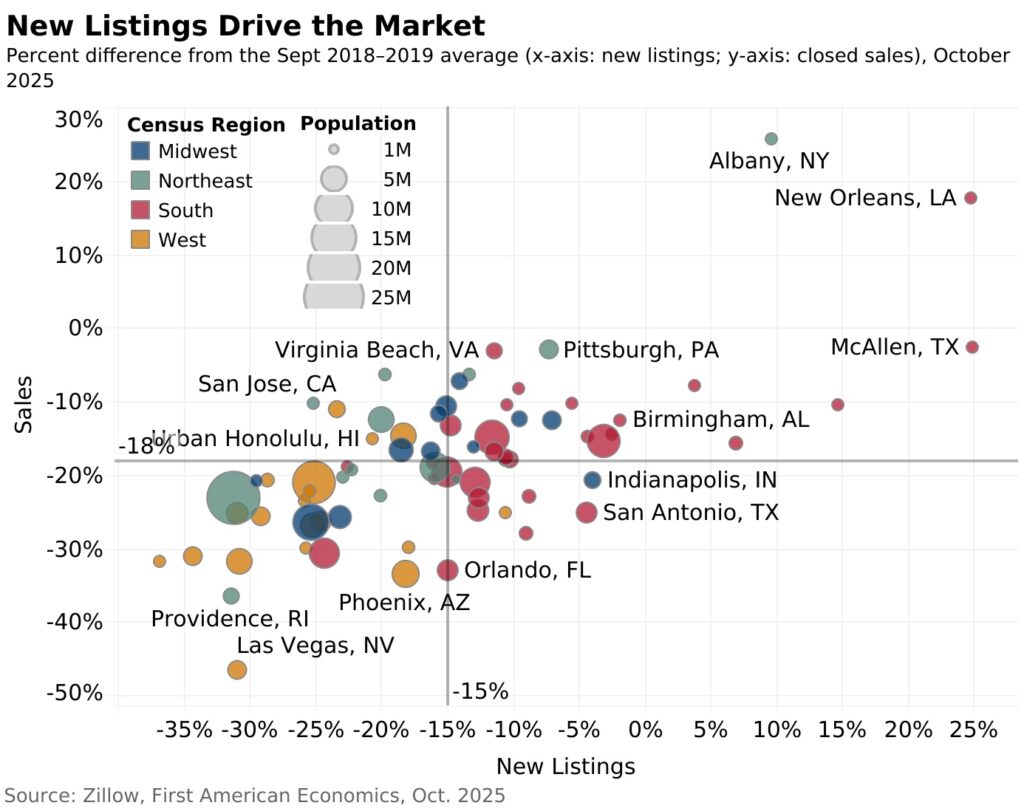
"Examining Sales & Listing Trends Nationwide"
"First American used a straightforward “how close to normal” assessment for both metrics by comparing October 2025 new listings and sales in 75 major markets to each market’s own October 2018–2019 average. Since flow is important for transactions, we concentrate on fresh listings. If properties take longer to sell, active inventory may rise, but new listings provide buyers additional possibilities. Using the 75-market average for each measure as the midlines, the outcome is a scatterplot with four quadrants."
>> To read more, Click Here